- Connected Care
- Healthcare AI
- Physician Burnout
- Clinical Workflow Automation
5 min. read
Everyone in healthcare AI is chasing the same fix: give physicians more information, faster. Fewer clicks. Smarter alerts. A better search box for the chart. But what if that was never the problem?
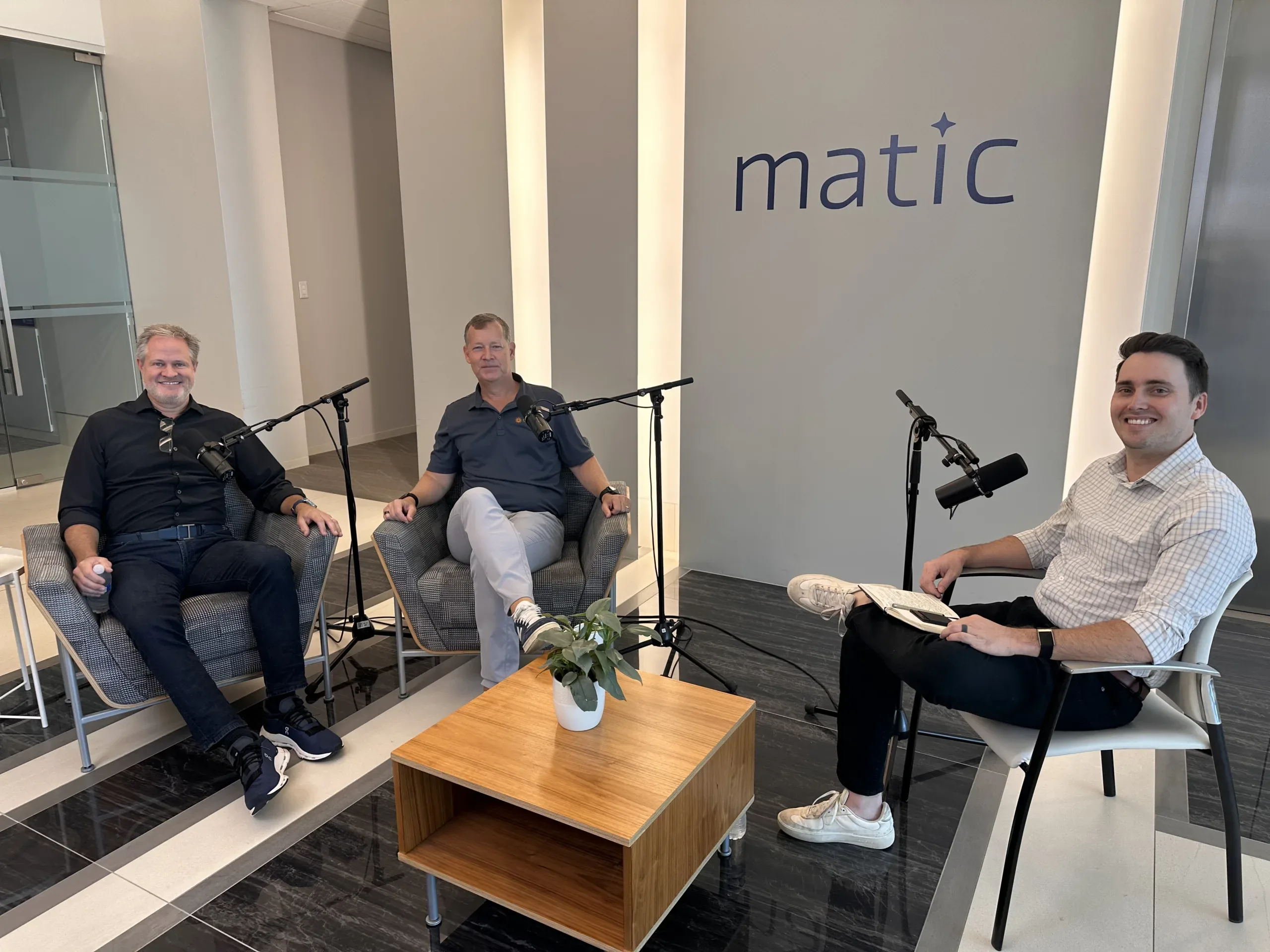
That’s the question at the center of the newest episode of Claims Denied, a Hospitalogy podcast. Host Blake Madden drove out to Plano, Texas on a hundred-degree August morning to sit down, in person, with Matic CEO Calvin Carter and Christopher Crow, MD, MBA, CEO and co-founder of Catalyst Health Group.
The two discuss why Dr. Crow thinks every lab-built AI product just repeats the EMR story, why he calls direct primary care a cottage industry born out of physician burnout rather than a model worth scaling.
The Story Behind the Partnership
Matic’s founding story doesn’t start in a hospital system or an EMR boardroom. It starts at Bottle Rocket, where Matic CEO Calvin Carter spent fifteen years building consumer apps for brands like Chick-fil-A and Southwest, companies that don’t get to hide behind “that’s just how healthcare works” when the experience is clunky. Consumers don’t tolerate friction. They uninstall it.
Calvin met Matic co-founder Dr. Alex Shepherd on an algorithmic trading side project. Alex holds a PhD in adversarial training for hallucinations and later went to medical school, in his words, because “finance is a zero-sum game.” Healthcare isn’t. That distinction, building something that grows the pie instead of just winning a trade, is baked into how we’ve built Matic from day one.
Then there’s Christopher Crow, MD, MBA, co-founder and CEO of Catalyst Health Group, a network built by physicians for physicians, over 850 clinicians and advanced practice providers caring for more than a million patients across Texas. Dr. Crow isn’t a vendor we sold to. He’s a partner who helped us build the product, week after week, shaping it around how his physicians actually practice.
On the episode, Dr. Crow makes a point that cuts against almost every AI pitch deck in healthcare right now: he thinks most lab-built AI products are just the EMR story on repeat. A powerful platform gets built, it gets bolted onto physician workflows from the outside, and clinicians end up serving the software instead of the other way around. Same pattern, new logo.
We built Matic to break that pattern, not extend it. That’s why Matic is EHR-agnostic by design: embedded where it needs to be, invisible where it should be, and never the reason a physician has to change how they practice. It’s also why Matic’s platform doesn’t stop at a transcription box. Clinical documentation, medical coding, clinical summarization, revenue cycle intelligence, care coordination, decision support: one connected system, not six vendors patched together with duct tape and login screens.
Dr. Crow also pushes back on the idea that direct primary care is the model to scale nationally. His read: DPC is a cottage industry that grew out of physician burnout, not a structural fix for primary care’s real bottleneck. It’s physicians voting with their feet, trading panel size for sanity, one small practice at a time. Understandable. Not scalable.
The real question the episode sits with is the one that matters most to us: what happens to a physician’s panel size, their income, and their patients’ access to care once you stop making the physician the bottleneck for every chart, every code, every inbox message, every follow-up? That’s not a documentation question. That’s a capacity question. And capacity is the thing primary care in this country has been short of for a decade.
Matic exists to answer it, not by replacing physicians with AI, but by giving physicians back the two-plus hours a day currently lost to admin, so they can see more patients, know more of them, and go home at a reasonable hour without a stack of unfinished notes waiting for them after dinner. Same-day chart closure. 99% accuracy. Ambient capture across 90+ languages. Multi-agent intelligence working in the background so physicians don’t have to think about the system at all, they just practice medicine.
The partnership with Catalyst isn’t a case study we wrote after the fact. It’s how the product got built. Real physicians, real specialties, real workflows, real friction points, refined in real time alongside the people actually using it every day.
That’s the difference between AI that gets adopted and AI that gets tolerated. One shows up as another system to manage. The other disappears into the work, giving physicians their time, their patients, and honestly, their evenings back.
Oh, and one more thing on the record: Dr. Crow went all-in on “Natty or bust” for the Texas Longhorns this season. Blake’s holding him to it. We’ll see how that ages.
Listen to the full episode of Claims Denied, a Hospitalogy podcast: “Primary Care’s Choke Point Was Never Knowledge,” featuring Calvin Carter and Christopher Crow, MD, MBA. Listen here.
Want to see what physician-built, physician-led clinical intelligence looks like in practice? Schedule a discovery call.